
Three models, one answer
How I turned MIT and Google Brain's multi-agent debate research into Mesh Mind, a chat app where three AI models critique each other before giving one answer.
Most AI chat apps put one model in front of you. You ask a question, it gives its first answer, and nothing pushes back. In 2023, researchers at MIT and Google Brain published Improving Factuality and Reasoning in Language Models through Multiagent Debate. Their finding was straightforward: give the same question to several models, make them critique each other's answers, and the result beats any single model working alone.
I built Mesh Mind as a live demo to see how that idea holds up in a real chat app. You can watch the Mesh Mind demo on X or watch the walkthrough on YouTube.
How the debate works
In the MIT and Google Brain paper, the baseline setup ran 3 models over 2 rounds. Across arithmetic, grade-school math, chess moves, and factual checks, debate beat single-model answers consistently, even across different model families like ChatGPT and Bard. Stopping at two rounds balanced accuracy against cost and wait time, and Mesh Mind keeps that same two-round structure.
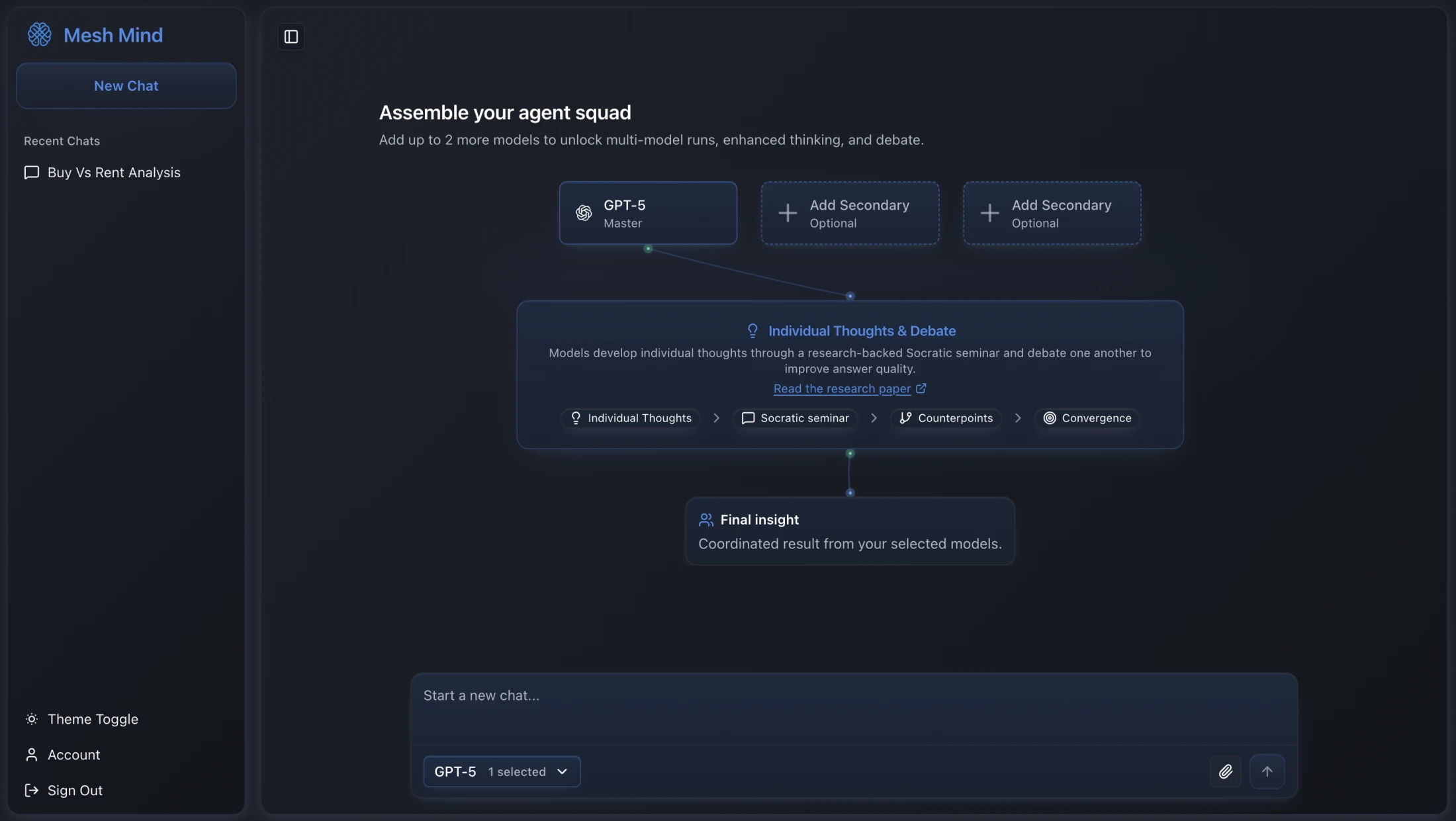
You pick one primary model and up to two secondary models from a lineup that includes GPT-5, Claude Opus 4.5, Gemini 3 Pro, Grok-4, and open-source models hosted on Groq. In round one, every model answers on its own at the same time. In round two, each model reads its peers' answers, defends its position if it holds firm, or explains why it changed its mind.
Once the revised answers finish, the primary model combines them into one reply. At the same time, a cheaper model reads the exchange and builds a summary table showing who agreed, who disagreed, and who changed course. Putting GPT-5, Claude Opus 4.5, and Gemini 3 Pro in the same room means agreement comes from separate training runs instead of copies of one model.
What it takes to make it usable
Turning a research protocol into a working app on Next.js and Convex came down to the seams around the models. Before a run starts, the server checks user permissions, rate limits, the weekly budget, and whether the primary model supports any attached files. Each model runs in its own separate thread tied to the signed-in user, so you can inspect what any model wrote in round one while the main conversation stays clean for follow-ups.
Every model card streams live from initial draft to debate to finished answer so nobody stares at a blank spinner. The server also validates the summary table before returning it so malformed output never reaches the screen. If one model fails mid-debate, its card displays which model failed and why right in place instead of hiding the error in server logs.
Cost needs to stay visible too. Running a three-model debate costs roughly three times as much as asking a single model, and providers report usage in inconsistent shapes. Mesh Mind checks estimated spend against a rolling weekly budget before each run, then reconciles the real cost afterward so bills stay predictable.
See the work
Credit belongs to the paper's authors: Yilun Du, Shuang Li, Antonio Torralba, Joshua B. Tenenbaum, and Igor Mordatch. You can try the live app at master-prompt-ten.vercel.app or read the source code at github.com/LaykenV/master-prompt.
If you want custom software that puts AI behind clear checks and predictable limits, tell me about your business or read about my contract engineering work.

Layken Varholdt is an AI engineer, an Air Force veteran and the founder of Varholdt Labs in Lafayette, Louisiana. More about Layken